
Criminal Cases in Camden County Courts
Camden County Superior Court, part of the Brunswick Judicial Circuit, hears felony prosecutions. Its clerk keeps the criminal index, filed pleadings, judgments, dispositions, and certified copies. Magistrate Court handles warrants, first appearances, and limited accusations. Municipal courts in Kingsland and St. Marys retain their own ordinance, traffic, and specified misdemeanor dockets. The correct custodian therefore depends on where the charge was filed, not just where the arrest occurred.
A city citation can remain in municipal court. A felony accusation or indictment belongs in Superior Court. When the level is unclear, identify the arresting agency, approximate date, and charge before calling a clerk. That short fact set helps staff distinguish a city case from a county case and locate the right index.
Kingsland Municipal Court handles ordinances, traffic, and certain misdemeanors at 533 N. Lee St. St. Marys Municipal Court handles ordinances and listed misdemeanors at 418 Osborne St. Their records remain apart from the Superior Court felony index, even when custody began at the same county jail.
Camden Criminal Clerk and Certified Copies
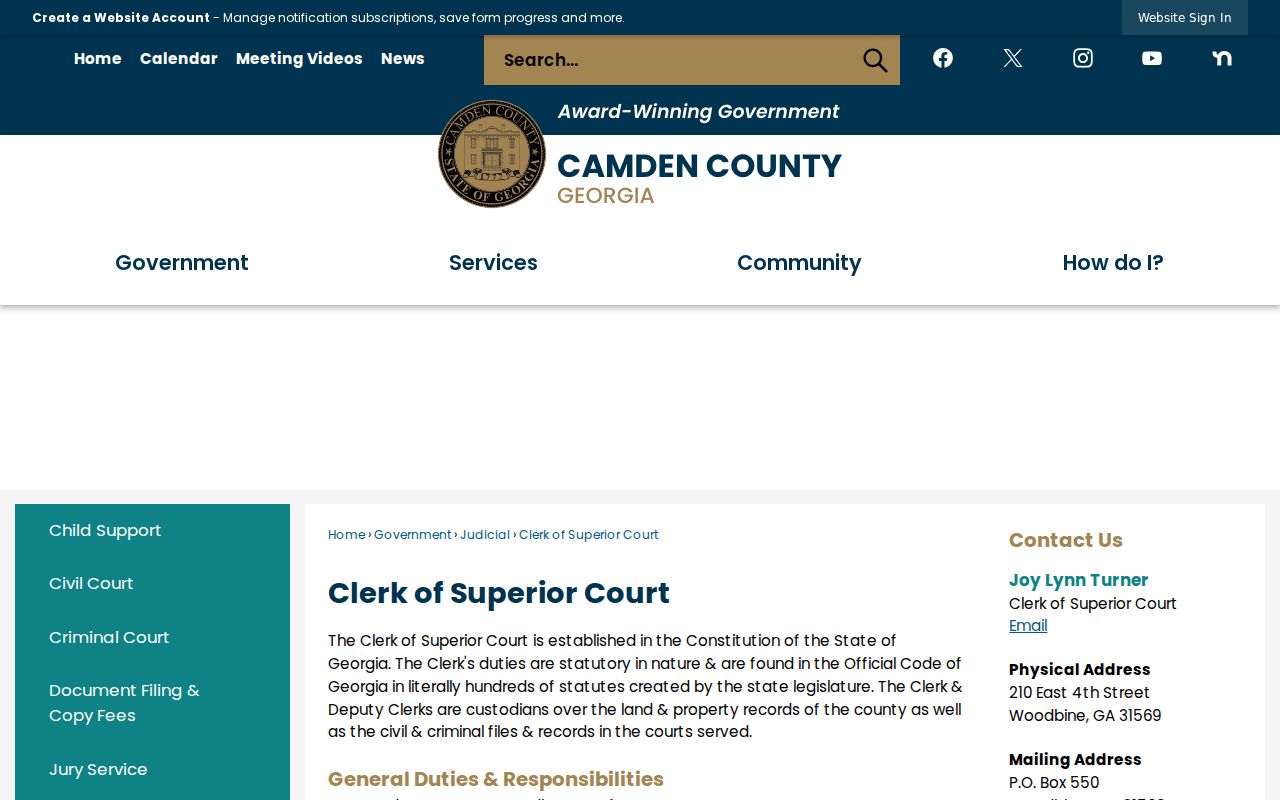
The Clerk of Superior Court is the main source for filed Camden County felony records. The public counter is at 210 E. 4th St., Woodbine, GA 31569, and is open Monday through Friday from 9 a.m. to 5 p.m. Call 912-576-5631. Bring the full legal name, an approximate filing or offense date, and a case number when available.
The official clerk page identifies the office and routes readers to its civil and criminal search. The image below shows that official access point.
Use a certified copy when the seal and clerk's attestation matter. Specify whether the request is for a judgment, warrant, disposition, or another filed document.
The clerk also publishes vault guidance, so older or non-digitized material may require staff help. Expect courthouse security screening and bring photo identification. No reviewed official source states a parking fee, device rule, or recording policy. Confirm current access conditions before traveling to Woodbine.
How to Search Camden County Case Records
The clerk's linked civil and criminal portal is the first remote stop. Georgia's Judicial Gateway serves as a statewide routing layer, but county data can remain in a clerk or vendor system. An online index is a locator, not certified proof. Match the name, court, filing date, and charge before relying on a result.
- Open the clerk's linked search and select the criminal case area.
- Search by exact case number when known, or use the party's legal name.
- Narrow the result with filing year, court, case type, or other controls shown.
- Open the docket and distinguish a filed charge from its final disposition.
- Ask the responsible clerk for an ordinary or certified copy of the needed document.
| Field Label | Type | Required | Notes |
|---|---|---|---|
| Last name | Text | Search route | Use the full current or case-file surname. |
| First name | Text | Helpful | Narrows common surnames. |
| Case number | Text | Alternative | Best exact-match key. |
| Filing year | Number/select | Optional | Separates similar names. |
| Case type or court | Select | Optional | Confines results to the proper docket. |
Georgia Routing for Camden Court Records
The Georgia E-Access to Court Records page explains how users reach participating court systems. Its routing screen is pictured below.
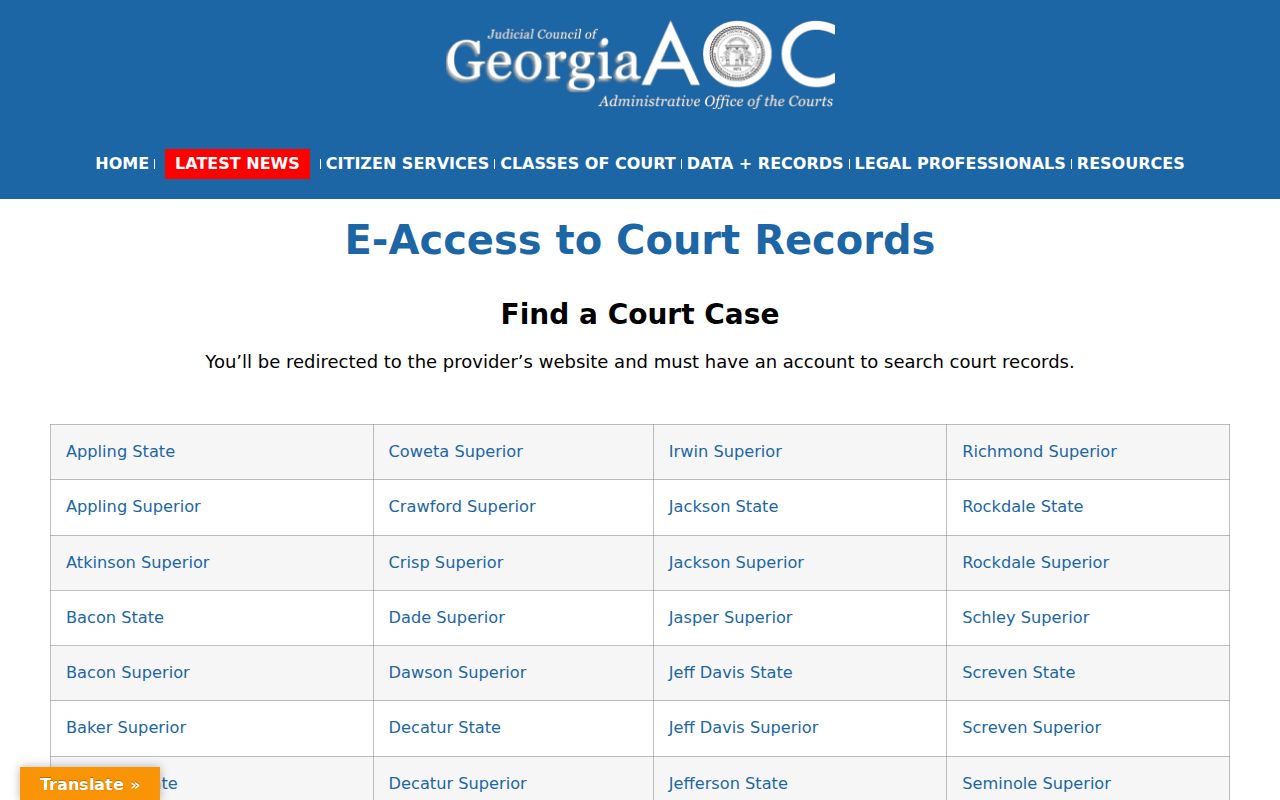
If the state page sends the search back to a Camden clerk or vendor, follow that route. A missing online result may reflect the wrong court, a delayed entry, an older record, or lawful restriction. Call the custodian rather than treating no result as proof that no case exists.
What the Camden Case File Shows
A Camden County case file follows the prosecution rather than jail custody. It can identify the charging instrument, attorneys, scheduled proceedings, rulings, plea, result, and punishment. Read each charge separately because one count may be dismissed while another ends in conviction.
| Case Number & Court | Unique file identifier and the court with jurisdiction. |
|---|---|
| Charging Document | Accusation, indictment, citation, or other formal charge. |
| Docket Entries | Filed motions, notices, orders, and event dates. |
| Hearing Dates | Past and scheduled arraignments, motions, plea, or trial settings. |
| Disposition & Judgment | The result for each charge, such as conviction, dismissal, acquittal, or nolle prosequi. |
| Sentence & Conditions | Confinement, probation, fines, restitution, and other ordered terms. |
Reading Camden Criminal Docket Results
A docket entry records that something was filed or happened. It does not always state the final outcome. In Georgia, an accusation is a prosecutor-filed charging instrument. An indictment follows a grand jury's true bill. Nolle prosequi means the prosecutor declined to continue a charge, while a dead docket marks a case inactive without necessarily ending it.
Check the disposition at the charge level and then inspect the signed judgment. If GCIC history lacks that result, the source court or prosecutor must correct its own submission. The clerk's filed document is the sound place to verify the Camden County court outcome.
A no bill means a grand jury declined an indictment. A true bill means it returned one. An acquittal is a not-guilty judgment, while dismissal ends a charge without conviction. Those terms should not be collapsed into one closed label.
Stages of a Camden County Criminal Case
After an arrest or citation, a judge may address first appearance and bond. The prosecutor then chooses the formal charge. A defendant is arraigned and enters a plea. Discovery and motions precede a negotiated plea or trial. The court records a separate disposition for each count and imposes sentence after a conviction. An appeal can create another record in an appellate court.
Case flow: Charges Filed › Arraignment › Pretrial › Plea or Trial › Disposition › Sentencing
Historic Camden Court and Jail Records
Modern criminal dockets and genealogy searches do not follow the same trail. Camden County's official List of Bound Records identifies Sheriff's Sales from 1807 through 1826 and a county jail register from 1921 through 1923.
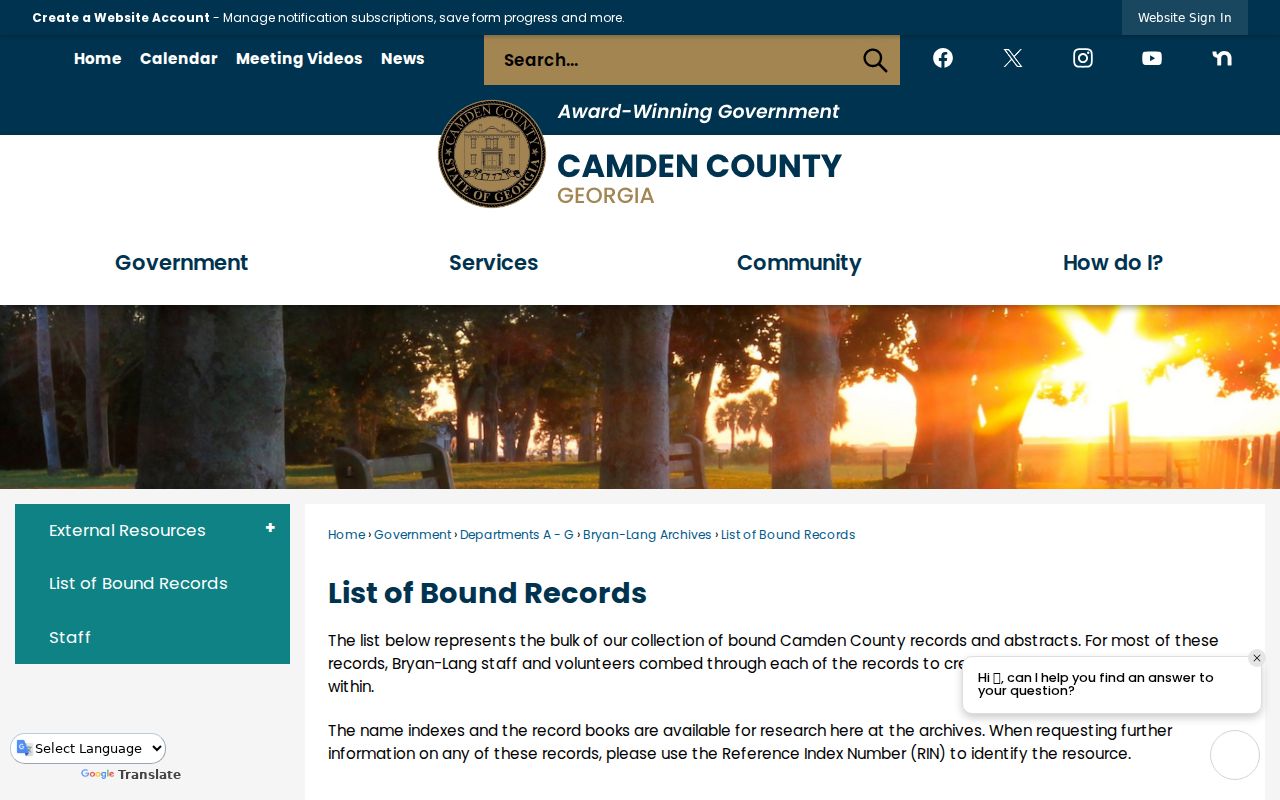
Some originals are held by the Georgia Archives. Ask the Camden clerk or county vault about the series and date before traveling. That avoids forcing an archival request through a modern criminal case portal.
Federal Cases Connected to Camden County
Federal prosecutions are not filed in Camden Superior Court. The U.S. District Court for the Southern District of Georgia is the proper federal court source.
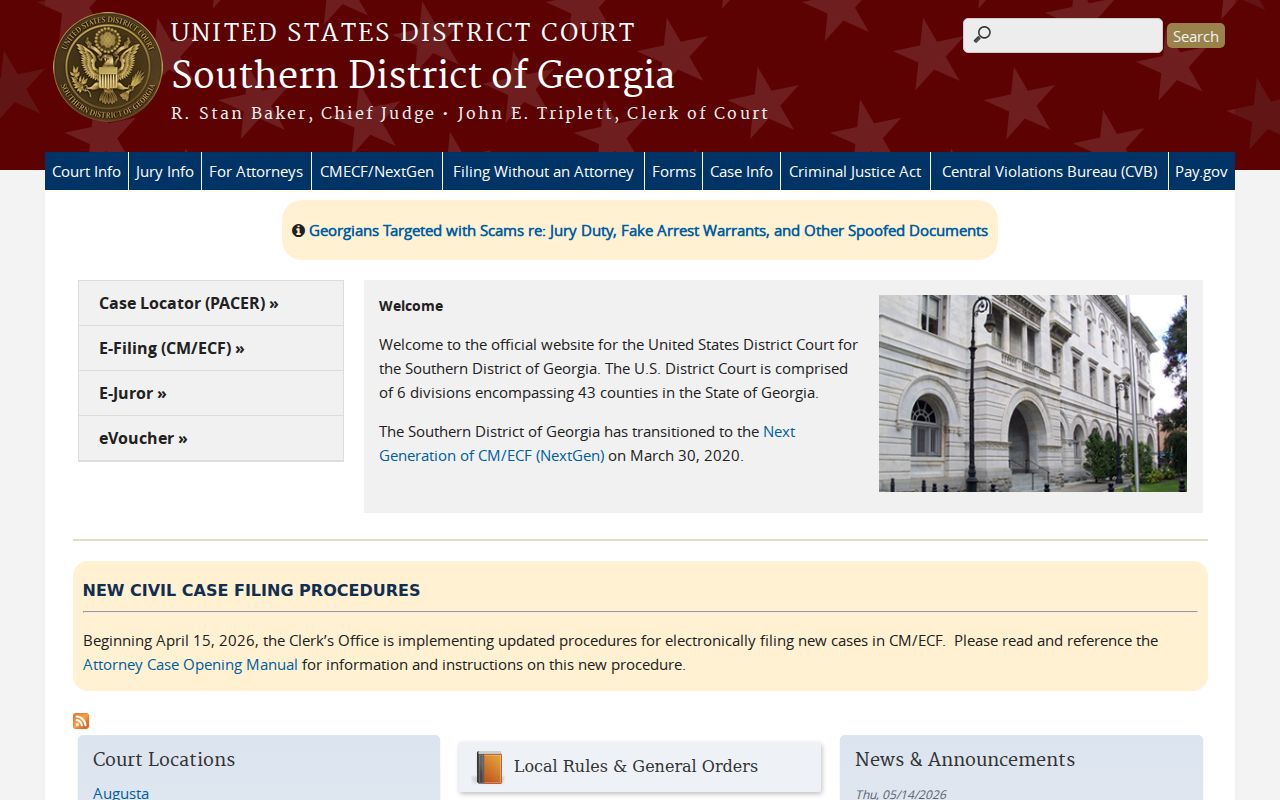
Public federal docket access generally runs through PACER, whose official interface is shown below.
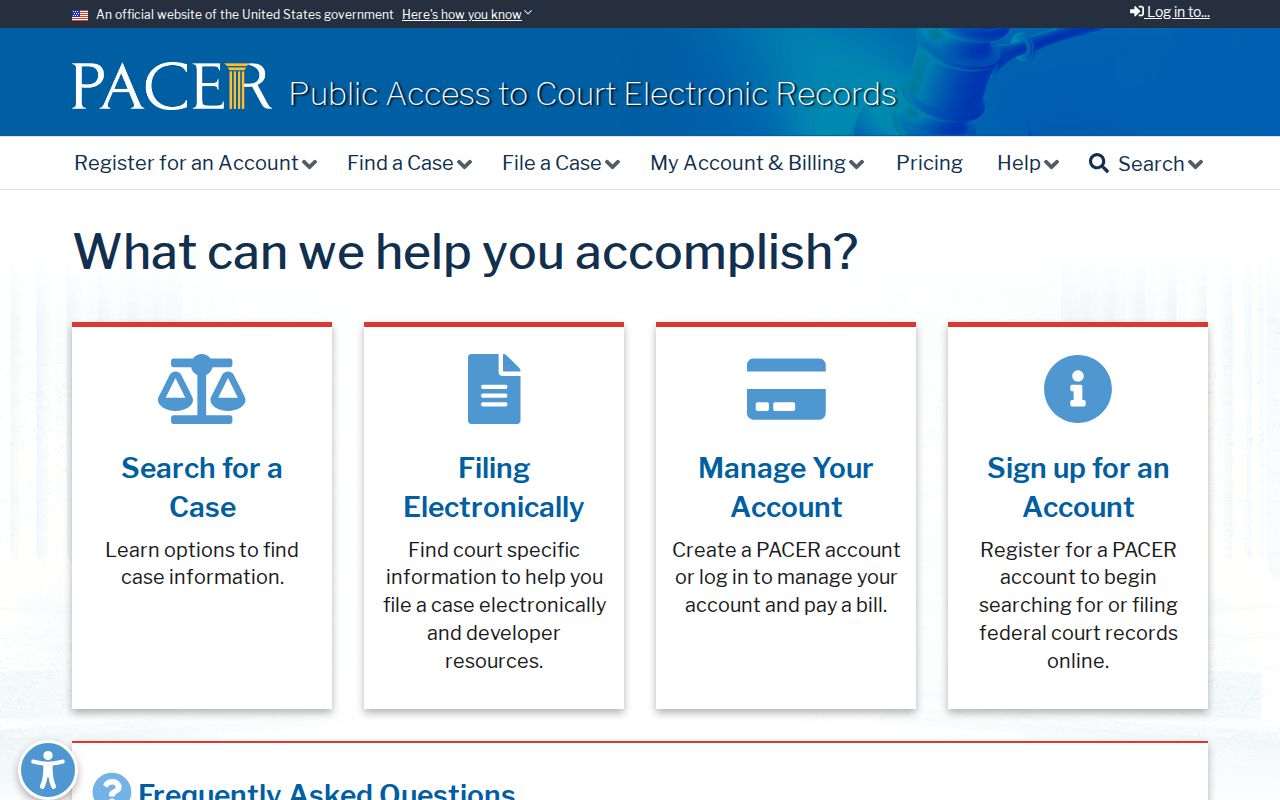
Search the federal system only when the matter was prosecuted under federal law. A federal docket will not replace the separate Camden County file for a state charge.
Camden Case Record Access and Restrictions
Georgia policy favors access to nonexempt public records, but court files follow clerk access rules and judicial sealing orders. Juvenile records, protected victim or minor identifiers, sealed documents, and sensitive personal data may be withheld or redacted. An online view can also show less than the paper file.
For a file that does not appear online, give the clerk enough detail to test the correct index. A full name, approximate year, court, charge, and known case number are more useful than a broad request. Ask whether the file is held at the counter, in the vault, or by another court. A three-business-day Open Records Act response rule applies to agency records, but it should not be treated as a promise that every court copy will be produced on that schedule.
Restriction of an eligible GCIC arrest cycle does not by itself erase every court docket. O.C.G.A. §35-3-37(m) provides a separate path to ask a court to seal clerk, prosecutor, or arresting-agency records when its conditions are met. Ask the Camden clerk about the current filing process and fees. For wider county context, the Camden County criminal history overview distinguishes court, sheriff, and state records.
Active sealed matters are not made public merely because another record mentions an arrest. Likewise, a redacted online docket is not proof that the clerk's lawful public copy contains no additional page. State the exact document needed and let the custodian apply the governing order and access rules.